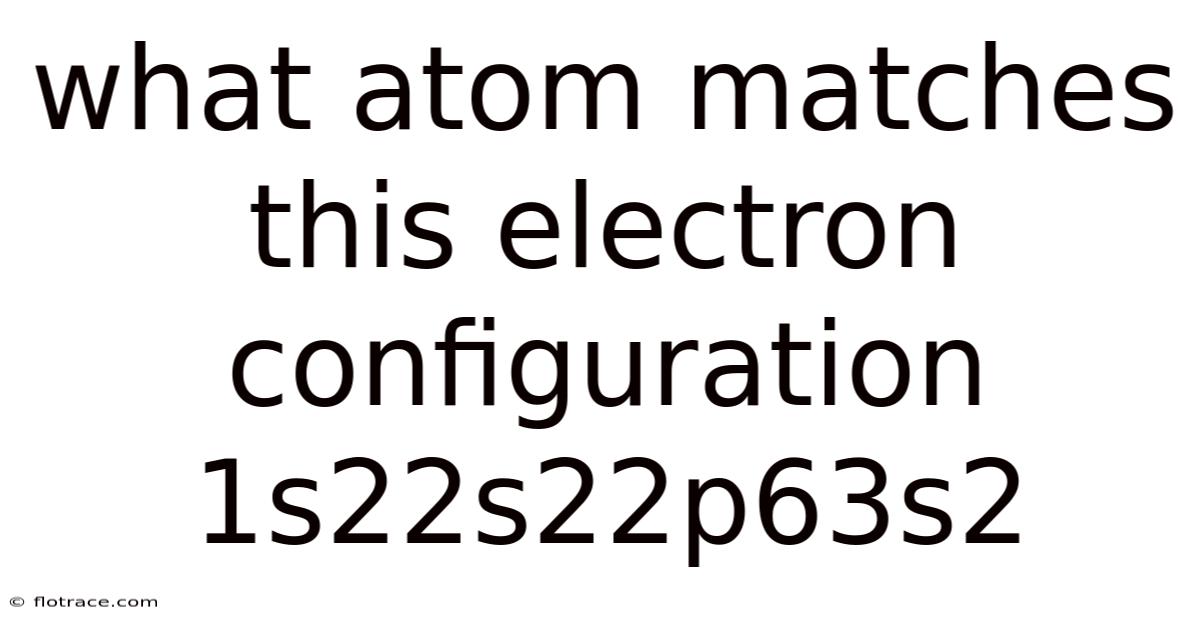
Of course. Here is a complete, in-depth article about the atom that matches the electron configuration 1s²2s²2p⁶3s².
Unraveling the Code: The Atom with Electron Configuration 1s²2s²2p⁶3s²
In the vast and layered world of chemistry, the behavior of every element is dictated by a fundamental blueprint: its electron configuration. This arrangement of electrons within an atom's orbitals is the key to understanding why elements react the way they do, what kind of bonds they form, and what their unique properties are. One of the most common questions in introductory chemistry is identifying an element from its electron configuration. The configuration 1s²2s²2p⁶3s² is a classic example, and by decoding it, we uncover the identity of a vital and familiar element: Magnesium The details matter here..
This article will take you through a step-by-step analysis of this configuration, explaining not just what the element is, but why it is, and exploring the remarkable properties that make it so important.
Step 1: Decoding the Configuration Notation
Before we can identify the atom, we must understand the language of electron configurations. The notation is a shorthand that describes the distribution of electrons around the nucleus Practical, not theoretical..
- Numbers (1, 2, 3): These are the principal quantum numbers (n), which represent the main energy levels or "shells." Higher numbers indicate shells that are farther from the nucleus and can hold more electrons.
- Letters (s, p, d, f): These denote the subshells, which are shaped differently and have different capacities. The 's' subshell can hold a maximum of 2 electrons, the 'p' subshell holds 6, the 'd' subshell holds 10, and the 'f' subshell holds 14.
- Superscripts (², ⁶): These numbers indicate how many electrons are present in that specific subshell.
So, the configuration 1s²2s²2p⁶3s² can be read as:
- In the first energy level (n=1), the 's' subshell is full with 2 electrons.
- In the second energy level (n=2), the 's' subshell has 2 electrons and the 'p' subshell is full with 6 electrons.
- In the third energy level (n=3), the 's' subshell has 2 electrons.
Step 2: Counting the Total Number of Electrons
The most direct method to identify a neutral atom is to count the total number of electrons it possesses. Practically speaking, in a neutral atom, the number of electrons is equal to the number of protons, which is the atomic number (Z). The atomic number is the unique identifier for every element on the periodic table And that's really what it comes down to..
This changes depending on context. Keep that in mind It's one of those things that adds up..
Let's sum the electrons from the configuration:
- 1s² = 2 electrons
- 2s² = 2 electrons
- 2p⁶ = 6 electrons
- 3s² = 2 electrons
Total Electrons = 2 + 2 + 6 + 2 = 12 electrons
Step 3: Finding the Element on the Periodic Table
Since this is a neutral atom with 12 electrons, it must also have 12 protons. We now look for the element with the atomic number 12. Consulting the periodic table, we find that the element with Z=12 is Magnesium, with the chemical symbol Mg.
So, the electron configuration 1s²2s²2p⁶3s² belongs to the element Magnesium.
Step 4: Understanding Magnesium's Position and Properties
Knowing that Magnesium is the answer is just the beginning. The configuration itself reveals a great deal about its placement and behavior.
A. Group and Period: Magnesium is located in Group 2 (or IIA) and Period 3 of the periodic table It's one of those things that adds up..
- Its placement in Period 3 is directly given by the highest principal quantum number in its configuration, which is 3 (from the 3s² electrons).
- Its placement in Group 2 is determined by its valence electrons—the electrons in the outermost energy level. For Magnesium, the outermost shell is the n=3 shell, which contains only the 2 electrons in the 3s subshell. Elements with 2 valence electrons are found in Group 2, also known as the alkaline earth metals.
B. The Noble Gas Shorthand: A more efficient way to write electron configurations is using the preceding noble gas. The noble gas that precedes Magnesium is Neon (Ne), which has the configuration 1s²2s²2p⁶. This is identical to the first part of Magnesium's configuration. Which means, the shorthand notation for Magnesium is [Ne] 3s². This clearly shows that Magnesium has the stable electron core of Neon plus two additional electrons in the 3s orbital Not complicated — just consistent..
C. Chemical Reactivity and the Drive for Stability: Atoms are most stable when their outermost energy level is full, a condition often achieved by having a configuration similar to the noble gases. Magnesium, with its 2 valence electrons, can achieve this stability in one of two ways:
- Losing two electrons: By losing its two 3s electrons, Magnesium forms a positively charged ion, Mg²⁺. This ion has the exact same stable electron configuration as Neon ([Ne]). This is the most common and energetically favorable reaction for Magnesium. It readily donates these two electrons in chemical reactions, making it a strong reducing agent.
- Gaining six electrons: While possible, it is highly energetically unfavorable for Magnesium to gain six electrons to fill the 3p subshell. So, it almost exclusively forms cations (Mg²⁺) rather than anions.
This tendency to lose two electrons explains why Magnesium forms ionic compounds with elements that need two electrons, such as Oxygen (O²⁻) in Magnesium Oxide (MgO), or with halogens like Chlorine (Cl⁻) in Magnesium Chloride (MgCl₂) Small thing, real impact..
The Significance of Magnesium: From Biology to Industry
The simple electron configuration 1s²2s²2p⁶3s² describes an element that is indispensable to life and modern technology.
- Biological Role: Magnesium is a crucial mineral for all living organisms. It is a cofactor for over 300 enzyme systems that are vital for processes like energy production (ATP), protein synthesis, muscle and nerve function, and maintaining healthy bones and teeth. It is the second most abundant intracellular cation in the human body.
- Material Science: Due to its low density and high strength-to-weight ratio, Magnesium alloys are used extensively in the aerospace, automotive, and electronics industries for lightweight structural components.
- Chemistry: In the lab, Magnesium metal is used in Grignard reagents for organic synthesis and as a reducing agent in various industrial processes.
Conclusion: The Power of a Simple Code
The journey from the abstract string of numbers and letters—**1s²2s²2p⁶3
s² denotes the two valence electrons populating the third shell, completing the configuration. This concise notation not only flags magnesium as a member of the alkaline‑earth family but also predicts its characteristic behavior: the ready loss of those two electrons to generate a stable Mg²⁺ ion that mirrors the neon core. Because the outermost level is only half‑filled, the element readily participates in reactions that achieve a full octet, either by donating the electrons or by sharing them in covalent bonds. Its relatively low first ionization energy means that even modest energy input can liberate the valence electrons, a fact that explains its vigorous reaction with water, acids, and many oxidizing agents.
Counterintuitive, but true.
The shorthand [Ne] 3s² streamlines the description of magnesium’s electronic structure, allowing chemists to write formulas such as MgO or MgCl₂ with ease and to anticipate the stoichiometry of the compounds it forms. Think about it: in spectroscopic analysis, the same notation serves as a reference point for interpreting energy levels and transition probabilities, while quantum‑chemical models rely on it to construct accurate electronic wavefunctions. Thus, the simple string of numbers and letters becomes a universal code that bridges the microscopic world of electrons with the macroscopic properties we observe That's the part that actually makes a difference..
Understanding this compact representation illuminates why magnesium is so ubiquitous in biology—its ions are essential cofactors for enzymes that drive ATP synthesis, DNA replication, and muscle contraction—and why it is prized in engineering for its low density and high strength‑to‑weight ratio in lightweight alloys. The same electron arrangement that makes magnesium a potent reducing agent also underpins its role in modern technology, from battery electrodes to flame‑retardant compounds.
No fluff here — just what actually works.
In essence, the elegance of electron configuration lies at the heart of magnesium’s chemical identity. From the neon‑like core to the two ready‑to‑go electrons, this compact code determines reactivity, dictates the types of compounds it forms, and explains its profound influence on living systems and contemporary industry. Recognizing the power of such a concise description reminds us that the language of electrons is the foundation upon which the properties of matter are built.
